


Pilates is a low-impact, mind-body exercise method that builds strength, control, flexibility, and body awareness through slow, precise movement and deliberate breathing. You can practice it on a mat or on spring-based equipment such as the Reformer, and almost every exercise can be made easier or harder. That adaptability is why beginners, athletes, and people returning to movement all use it.
This guide covers where Pilates came from, how it works, what research does and does not show, and what a first class feels like. It is general education, not medical advice.
What Is Pilates?
At its core, Pilates is a system of controlled exercises that teach your body to move well. Instead of chasing speed, heavy weight or a racing heart rate, you work through precise movements while paying attention to your breath, your alignment and which muscles are actually doing the work.
Many exercises start from the center of the body, often called the powerhouse: the abdominals, lower back, hips and glutes. From that steady base, your arms and legs move with more control. A single exercise often challenges the core, shoulders and legs together.
One honest caveat: a typical session is not a cardio workout. An American Council on Exercise study of mat sessions concluded that the cardiovascular benefits appear limited, though it still called Pilates a valuable way to build core strength and flexibility. Many people pair it with walking, cycling or swimming.
A Short History of Pilates
Joseph Hubertus Pilates was born on December 9, 1883, in Mönchengladbach, Germany. By most accounts, he was a sickly child with asthma, rheumatic fever and rickets, and he turned to gymnastics, boxing, yoga and other disciplines to get stronger.
He was in England when World War I began. The Pilates Method Alliance describes the method as designed to rehabilitate detainees during the war. Other details of that period, such as the story of springs attached to hospital beds, vary by source, so treat them as part of the method's lore.
Pilates moved to New York City in 1926 and opened a studio with Clara. Dancers became early devotees, and the method became a fixture of dance training and injury recovery. He set out his approach in two short books, Your Health (1934) and Return to Life Through Contrology (1945), and taught until he died in 1967 at age 83.
One practical legacy comes from Britannica's Pilates entry: a federal court ruled in 2000 that the word "Pilates" is a generic term. Anyone can use the name, so instructor training varies. We come back to that in the safety section.
What does Contrology mean?
Pilates called his method Contrology. The name points to the idea at the center of his work: deliberate control of movement matters more than speed or repetition count. It is still the clearest way to tell Pilates apart from many workouts. The question is less how many reps you finished and more how well you controlled each one.
How Does Pilates Work? The Core Principles
Pilates works by asking you to slow down and move with intent. Body weight or spring resistance challenges the muscles, while breath and focus keep your form honest. Teachers commonly describe the method through six principles:
- Breathing. Pairing each movement with a steady inhale and exhale, often expanding the ribs sideways instead of lifting the shoulders.
- Concentration. Staying mentally present, because a distracted rep rarely looks like a good one.
- Control. Choosing the speed and range of each movement rather than relying on momentum.
- Centering. Starting movement from the trunk and hips so the limbs move from a stable base.
- Precision. Placing each body part on purpose, since small alignment details change what an exercise trains.
- Flow. Linking exercises smoothly so a session feels like one continuous sequence.
Together, these make Pilates feel more like practicing a skill than grinding through a workout. Over time, that skill focus can sharpen body awareness: noticing how you stand, sit, and move.
Mat Pilates vs. Reformer Pilates
The two most common ways to practice are mat Pilates and equipment-based Pilates, and the Reformer is the best-known apparatus.
Neither is better for everyone. Mat work teaches fundamentals and travels anywhere. The Reformer lets an instructor fine-tune resistance and support. Head-to-head research is limited and mostly small. In one trial of people with multiple sclerosis, both formats improved balance, functional mobility, core stability, fatigue and quality of life, and the Reformer group gained more trunk flexor strength. Your best choice depends on your goals, access and instruction. To compare the studio's own classes, read Which Pilates class is right for you?.
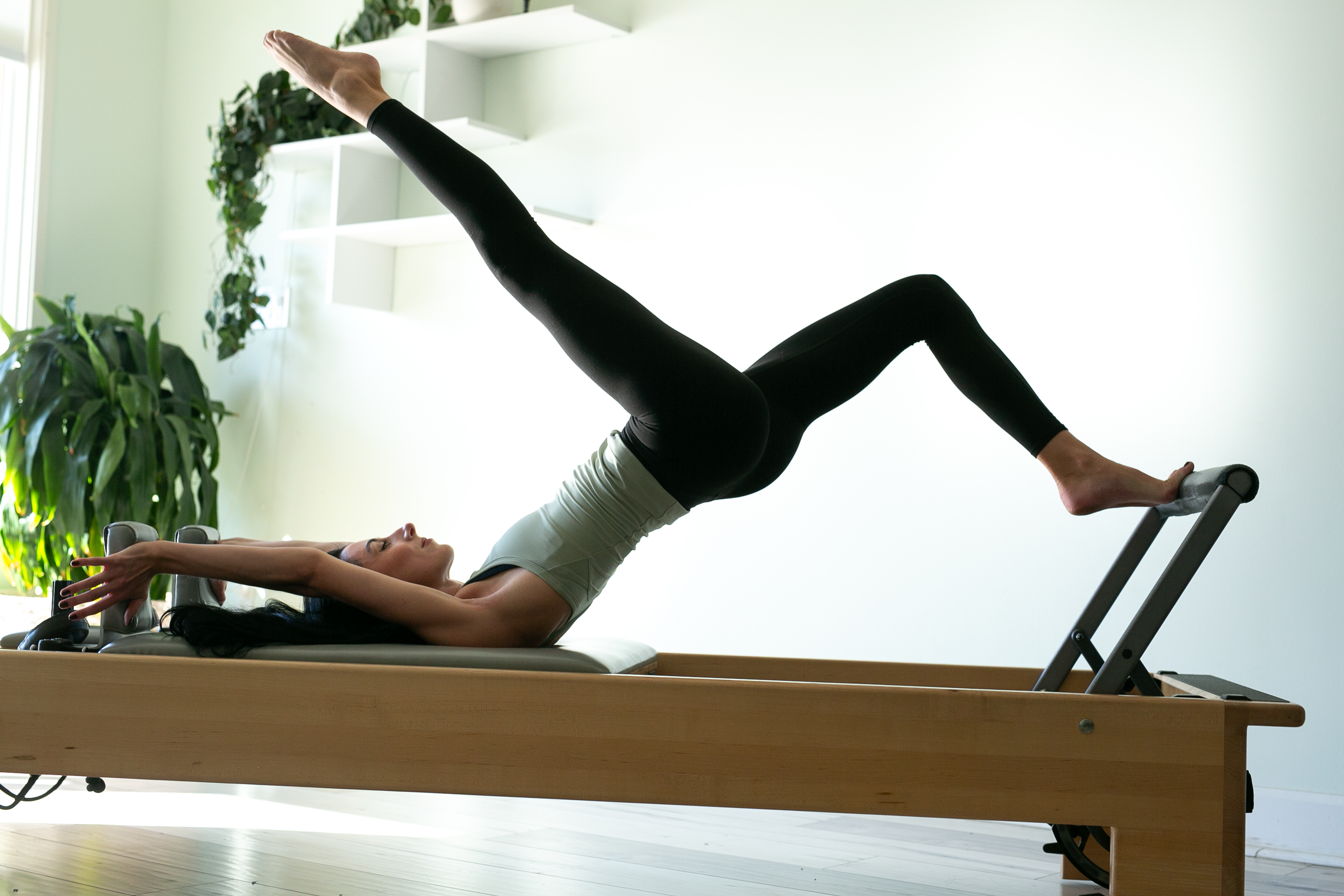
Common Pilates Equipment
- Reformer. A sliding carriage on a frame with springs, an adjustable footbar, straps and shoulder blocks. You push or pull against spring tension while lying, sitting, kneeling or standing. Some Reformers accept a padded jump board for low-impact jumping while lying down.
- Cadillac or tower. A tall frame with springs, bars and straps that supports a wide range of exercises. Tower attachments also fit on some Reformers.
- Chair and barrel. A chair with a spring-loaded pedal and a curved barrel that supports the spine, both used for strength and mobility work.
- Small props. Resistance bands, a Pilates ring, small balls and foam rollers.
One surprise for newcomers: more spring tension does not always mean a harder exercise. In some movements springs assist you, and in others they resist you. That is why setup from an instructor matters when you are new.
Benefits of Pilates: What the Research Shows
Pilates has a sizable research base, but quality varies, and many trials are small. Here is what the stronger evidence supports, with the caveats attached.
- Low back pain. A Cochrane review summarized in American Family Physician covered 10 randomized trials and found low to moderate-quality evidence that Pilates reduces pain and disability compared with minimal intervention. It found no conclusive evidence that Pilates beats other exercise, so choosing it can reasonably come down to preference and access. The studio's article on Pilates for lower back pain looks at the topic in more depth.
- Balance and falls in older adults. A 2021 meta-analysis of 39 studies reported moderate effects on balance, strength, flexibility and daily function and a large effect on fall risk compared with control groups. Certainty was low for balance, flexibility and function and moderate for strength and falls, so read the results as promising, not final. For a local angle on staying strong with age, see balance, bone density and the beach.
- Fitness and quality of life in inactive adults. In a randomized trial of 78 inactive women, 16 equipment-based sessions over eight weeks improved functional capacity and quality of life compared with a control group.
- Core, posture and flexibility. Young Women's Health, a guide from Boston Children's Hospital, says Pilates strengthens the core and supports posture, flexibility and balance. These benefits are widely reported, though the strength of evidence differs by outcome. The studio's posts on Reformer Pilates for better posture and The Posture Reset cover the posture side.
Pilates is not a proven cure for pain; it cannot promise injury prevention, and it is not an efficient route to weight loss on its own. Results depend on the person, the instruction, and consistency. For the studio's own view of why people choose it, see Why Pilates.
Which Muscles Does Pilates Work?
Pilates is best known for the core, but it trains the body as a connected whole.
- Trunk. The deep and surface abdominals, the obliques and the muscles along the spine, with the diaphragm and pelvic floor involved in breathing and pressure control.
- Hips and glutes. Bridges, side-lying work and Reformer footwork train the glutes, hip rotators and inner thighs.
- Shoulders and upper back. Arm work challenges the muscles that steady the shoulder blades.
- Legs. Footwork and leg series work the thighs, hamstrings and calves while the trunk stays steady.
Mayo Clinic's beginner guide describes the emphasis as the abdominals, lower back, hips and thighs. Pilates also asks small stabilizing muscles to work alongside larger ones, and repeated controlled holds build muscular endurance, which is why small movements can feel surprisingly hard.
Pilates Exercises for Beginners
Most beginner programs start with a handful of foundational movements. Your instructor will adjust each one to your body.
Exercise names and variations differ between schools, so expect some differences from class to class.
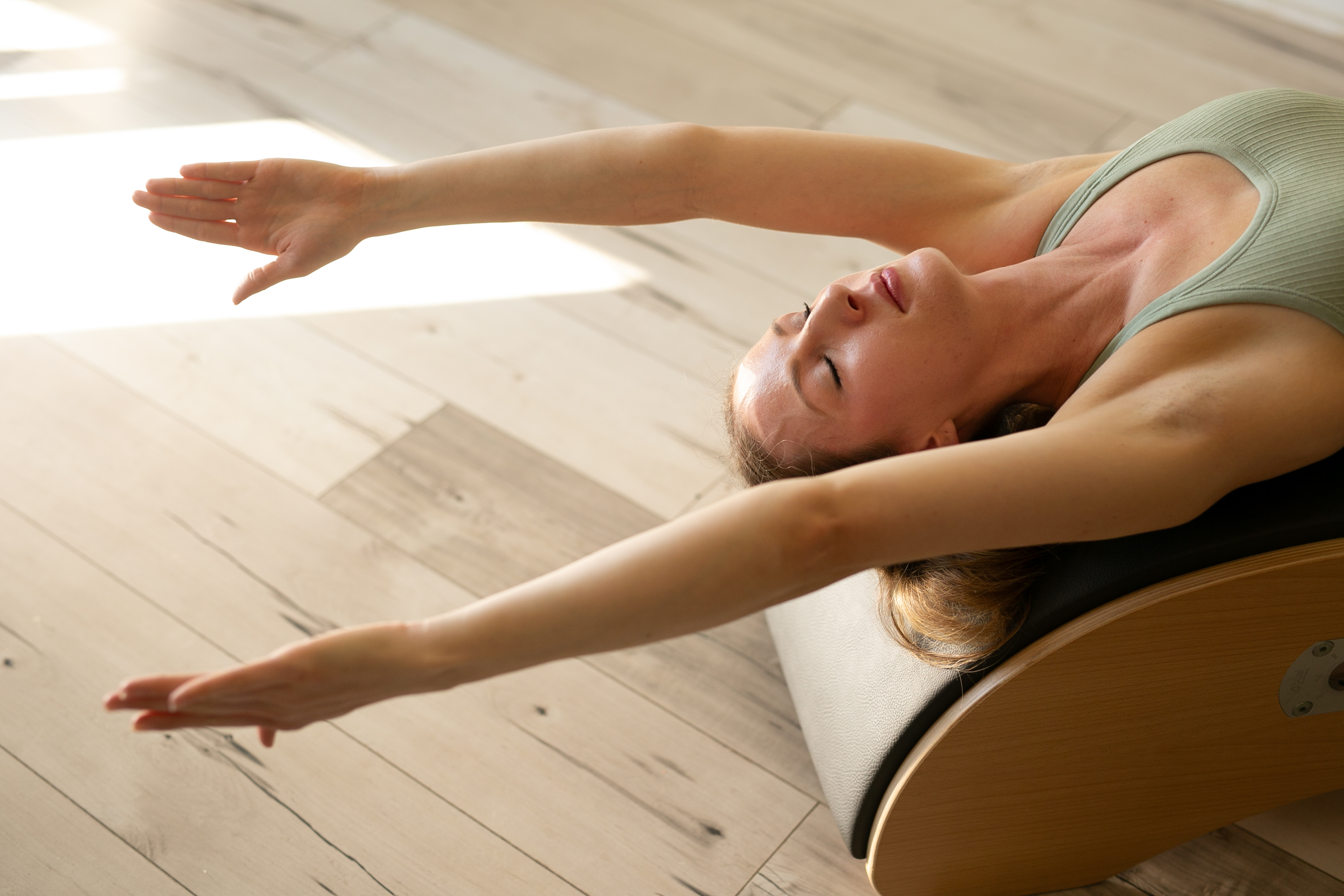
Is Pilates Good for Beginners?
Yes. Pilates suits many fitness levels because the load, range of motion, and support can all be adjusted. Mayo Clinic's guide advises beginners to start under an experienced instructor to learn good form, and to check with a doctor first if they are over 40, have not exercised in a while, or have health problems. Young Women's Health advises anyone with a serious back injury, joint problems, or pregnancy to talk with a health care provider first.
Levels exist for a reason. Foundational classes teach the basics, while flow-oriented classes suit people who already understand the principles. Active people often use Pilates alongside sport or strength training, and older adults may use it for balance and strength work. In every case, the right starting point depends more on your health history and goals than on your age or fitness label.
What to Expect in Your First Pilates Class
A first class is usually calmer than people expect. You arrive a few minutes early, share any injuries or concerns, and get set up on the mat or equipment. The instructor teaches breathing and basic positions before building into sequences. Movements are slow, cues are detailed, and you may notice muscles you rarely think about. Feeling pleasantly tired afterward is common. Sharp pain is not, so speak up if something hurts. For a full walkthrough, read what to expect in your first Pilates class.
How Often Should Beginners Practice?
Young Women's Health suggests beginners can start with two to three sessions a week and stresses consistency. Research protocols vary. The randomized trial above used two 60-minute sessions a week for eight weeks. A realistic starting point for many people is one or two classes a week, adding more as your body adapts and your schedule allows. The best plan is one you can keep, with rest days and other activities you enjoy. Not sure when to go? The studio's guide to morning vs. evening Pilates can help.
Clothing, Equipment, Modifications and Safety
- Clothing. Wear comfortable, fitted clothes that let you move freely. Loose tops can catch on equipment. Many studios require grip socks, and Pilates of San Diego does as well. At home, use a nonslip mat.
- Modifications. A good instructor offers options such as a smaller range, bent knees or props. Using them is smart technique, not a step down.
- Health conditions. Tell your instructor about injuries, recent surgery, pregnancy or chronic conditions, and ask your clinician which movements to avoid. Pilates of San Diego has written about postpartum recovery in private sessions and Pilates in cancer recovery.
- Pain signals. Mild muscle fatigue is normal. Sharp pain, dizziness or numbness are reasons to stop and speak up.
- Instructor training. Because "Pilates" is a generic term, ask where an instructor trained, how long they have taught, and whether they offer modifications.
Getting Started at Pilates of San Diego
Pilates of San Diego has three studios: East Village downtown, Del Mar on Camino Del Mar, and Fairbanks Ranch in Rancho Santa Fe. The Reformer is the studio's base apparatus, and the East Village and Fairbanks Ranch pages describe six reformers per class. Location pages also mention mat classes, so check the current schedule for what is offered.
The studio suggests starting with a group Reformer class or, if you want more hands-on guidance, an introductory private session. Re:Form is described as a foundational class for beginner and intermediate clients, and Form/Tower welcomes all levels. Private sessions are available one-on-one or as duets, and the studio recommends a private session first if you have a medical concern. To see how group classes compare with private work, read why group Reformer classes are the sweet spot.
Plan to arrive 10 minutes early, wear fitted clothing, bring water and wear grip socks. You can meet the instructors, check pricing, read the full studio policies, then view the schedule and book or contact the studio with questions.
This article is for general education and does not replace advice from a health care professional.
Frequently Asked Questions
What does Pilates do for your body?
Pilates trains strength, control, flexibility, balance and body awareness through controlled movement. Most people feel it works the core, hips, back and shoulders together, and research suggests it can help with back pain and balance in some groups. It is not a cure-all, and results vary with consistency and instruction.
How does Pilates work?
It combines slow, controlled movements, focused breathing, and either body weight or spring resistance to challenge muscles while you attend to alignment. That emphasis on control is what separates it from workouts built around speed or volume.
Is Pilates good for beginners?
Yes, because exercises can be modified and progressed. Start with a foundational class or an introductory private session, tell your instructor about any injuries, and check with your doctor first if you have health concerns.
Is Pilates the same as yoga?
No. Both are mind-body practices that emphasize breath and body awareness, but yoga has roots in ancient Indian practice while Pilates was developed in the early 1900s. Pilates sequences typically center on controlled, strength-focused exercises and often use spring-based equipment.
Can Pilates help you lose weight?
Not efficiently on its own. The ACE study found a session burns a relatively small amount of energy, so weight change depends mostly on your overall activity and eating habits. Pilates can complement other exercise by building strength and mobility.
Do I need a Reformer to do Pilates?
No. Mat Pilates needs only a mat, and many exercises use small props. A Reformer adds adjustable spring resistance and support, which is why many studios center their classes on it.

